

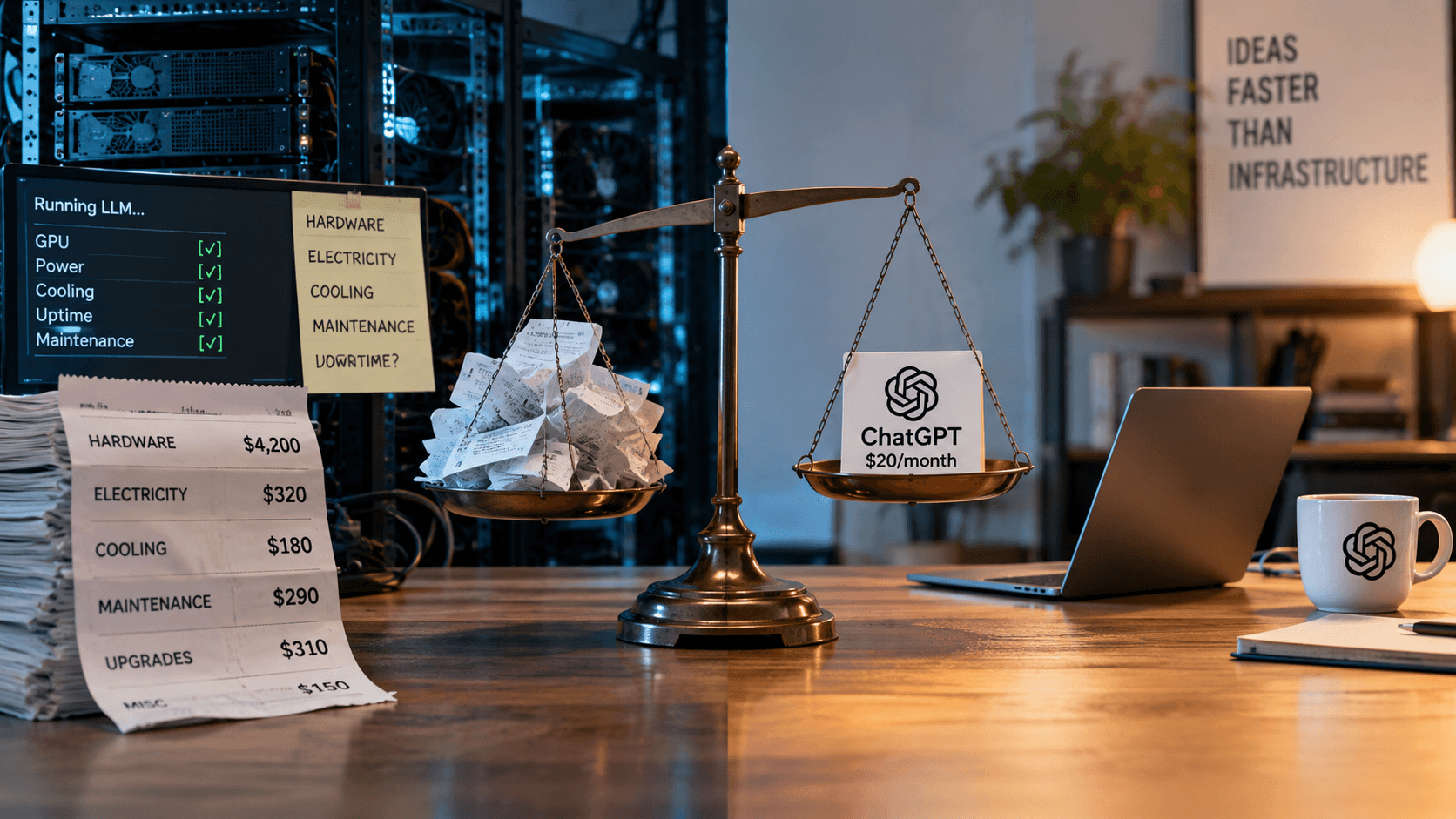
The Real Cost of Running Your Own AI vs. Paying for ChatGPT
A ChatGPT Business subscription has one line item: the price per seat. Running your own AI model has five.
That difference is where most of the confusion about “free” open-source AI comes from. The model itself, something like Meta’s Llama, Mistral, or OpenAI’s own gpt-oss, really can be downloaded at no license cost. What it takes to actually run that model for a business is a separate question, and it’s the one most comparisons skip.
AI total cost of ownership, or AI TCO, is the full cost of running an AI system, including compute, staff time, and upkeep, not just its subscription or license price. For a small business trying to decide between paying for ChatGPT and running its own model, TCO is the number that actually matters, and it’s rarely the one either side leads with.
What ChatGPT Actually Costs, by Team Size
Start with the easy side of the comparison, because it’s the simple one. ChatGPT’s Business plan runs roughly $20 per seat per month on an annual commitment, or $25 billed monthly, with a two-seat minimum. That cost scales in a straight line with headcount.
| 5-person team | 15-person team | 30-person team | |
|---|---|---|---|
| ChatGPT Business (annual) | ~$1,200/yr | ~$3,600/yr | ~$7,200/yr |
| What it includes | Everything: setup, updates, security, support | Same | Same |
| What you manage | User accounts and usage policy | Same | Same |
Enterprise-tier contracts, which add higher usage limits and admin controls, are a different animal: reported 2026 figures cluster around $60 per seat with a 150-seat minimum and an annual prepaid commitment, putting the floor near $108,000 a year. Almost no small business needs that tier, but it shows how far the per-seat model can climb.
What Running Your Own Model Actually Costs
Self-hosting swaps one bill for five smaller ones, and most of them don’t show up until the first month is over.
1Compute
You need a GPU-backed server to run the model, whether rented by the hour or bought outright. Pricing varies enormously by card and provider: high-end H100 GPUs rent for roughly $1.49 to $6.98 per GPU-hour across major clouds as of mid-2026, while older A100 cards can be found for well under $1 per hour on the open market. A lighter model like gpt-oss-20b, built to run in just 16GB of memory, doesn’t need the priciest card in the lineup, but it still needs one running continuously if the tool is going to be available during business hours.
2Setup and configuration
Downloading a model file is the easy part. Turning it into something a team can actually use, connected to the right documents, with reasonable guardrails, takes a technical provider’s time up front. That’s a project cost most comparisons leave out entirely.
3Ongoing maintenance
Open-weight models get new versions every six to eight weeks or so as the field moves. Someone has to evaluate whether an update is worth installing, apply security patches to the surrounding infrastructure, and watch for outages, none of which happens on its own the way it does with a hosted tool.
4Idle capacity
A GPU that sits mostly idle between requests still costs money the whole time it’s reserved. One cost analysis found that at 10% utilization, the effective cost per output token can run ten times higher than the same setup at full utilization, which is exactly the usage pattern a small team with sporadic AI use tends to produce.
5The person keeping it running
This is the cost that decides the comparison for most small businesses. Whether it’s a part-time contractor or a slice of a full-time hire, someone accountable for the system is not optional once client work depends on it. Estimates for a dedicated DevOps role supporting this kind of setup run well over $100,000 a year fully loaded, though a small business rarely needs a full role, usually a fraction of one, whether in-house or through a managed provider.
For a small business, the real cost of self-hosted AI isn’t the GPU. It’s the person who keeps it running.
Cloud, On-Premises, or a Managed Middle Ground
“Running your own AI” isn’t one option, it’s three, and each puts the cost in a different place.
| ChatGPT (Hosted) | Self-Hosted in the Cloud | Self-Hosted On-Premises | |
|---|---|---|---|
| Upfront cost | None | None, but usage billing starts immediately | $1,300 to $4,900+ for a workstation capable of running a 20B-class model, more for larger models |
| Ongoing cost | $20-25 per seat per month | Roughly $1 to $7 per GPU-hour depending on the card, billed only while running | Electricity and eventual hardware replacement; no recurring cloud bill |
| Who manages it | OpenAI, entirely | You or a provider, remotely | You or a provider, on hardware you own |
| Where data lives | OpenAI’s servers | A cloud provider’s data center, under contract terms you set | Your own office or server closet |
| Best fit | General work, low sensitivity, no in-house technical support | Sensitive data, variable usage, a provider handling upkeep remotely | Strict data-residency requirements, or usage steady enough to justify owned hardware |
There’s also a middle path worth naming: a managed provider hosting an open-weight model like Llama on your behalf, billed per token instead of per seat. Pricing varies widely, a 70-billion-parameter class model runs from roughly $0.10 to just over $1 per million input tokens depending on the host, cheap enough that a small team’s usage rarely adds up to much, without the hardware or on-call responsibility of running it yourself. It keeps the open-weight advantage, a model you’re not locked into, while handing the infrastructure to someone else. That’s often the more realistic starting point than either extreme, on-premises hardware or a full do-it-yourself cloud deployment.
Why the Break-Even Math Rarely Favors Small Teams
Cost analyses of self-hosting tend to describe a break-even point somewhere around 11 billion tokens of usage a month, the point where a self-hosted Llama-class setup can undercut API pricing by a wide margin. That volume corresponds to a business processing hundreds of millions of words of AI output every single day.
A 15-person company using AI for email drafts, proposal reviews, and internal notes is nowhere near that volume, and won’t be. That’s the honest reason cost alone rarely justifies self-hosting for a small team: the math that makes it cheaper assumes a scale most small businesses don’t operate at and don’t need to.
Where Self-Hosting Wins Anyway
None of this means the decision is settled by cost. It means cost isn’t the argument that should be doing the deciding, for most small organizations.
- Regulated or contractual data requirements. A healthcare practice, law firm, or nonprofit bound by a grant’s data-handling terms may need client information to stay on infrastructure it controls, regardless of what that costs relative to a subscription.
- A single high-value workflow. Moving one sensitive process, like case intake or donor records, to a controlled setup is a much smaller project than replacing every AI tool the business uses.
- Avoiding vendor-side change. A downloaded model can’t be altered or retired by a vendor the way a hosted one can. Digismart calls this exposure model dependency, and it’s a real, separate reason to self-host that has nothing to do with the monthly bill.
In every one of those cases, the decision is being made on privacy or control, with cost as a factor to manage rather than the reason itself. That’s a very different conversation than “open-source AI is free,” and it’s the one worth actually having.
Where to start
Digismart helps small businesses and nonprofits run this exact math before committing to either path. An AI audit maps what your team actually spends on AI tools today, what a self-hosted alternative would really cost to run, and whether the data you handle changes the answer. See the companion piece on whether open-source AI is worth it for the fuller decision framework.
ChatGPT’s price tag is the whole cost. Self-hosting’s price tag is where the cost starts.
A fifteen-person firm comparing a $3,600-a-year ChatGPT bill against a “free” open-weight model isn’t really comparing $3,600 to zero. It’s comparing $3,600 to a GPU bill, a setup project, and a standing question of who answers the phone when the model goes down at 9am on a Tuesday. Sometimes that trade is worth making. It should be made with the real number, not the sticker price.
Frequently Asked Questions
What is AI total cost of ownership (TCO)?
AI total cost of ownership is the full cost of running an AI system, including compute, staff time, and upkeep, not just its subscription or license price. It’s the number that matters when comparing a hosted tool like ChatGPT against a self-hosted open-weight model.
Is open-source AI actually free?
The model file itself is usually free to download under licenses like Apache 2.0. Running it in a way a business can rely on requires GPU hosting, setup work, ongoing maintenance, and someone accountable for keeping it online, all of which cost money even though the model license doesn’t.
Is self-hosting AI cheaper than ChatGPT for a small business?
Usually not on cost alone. The usage volume where self-hosting becomes cheaper than API or subscription pricing is far higher than what most small teams generate. Self-hosting tends to make sense for data privacy or compliance reasons first, with cost managed rather than minimized.
How much does ChatGPT Business cost for a small team?
Roughly $20 per seat per month on an annual plan, or $25 billed monthly, with a two-seat minimum. A 15-person team should expect to spend around $3,600 to $4,500 a year on that plan alone.
What’s the biggest hidden cost of running your own AI model?
Staffing. Compute and setup are visible, one-time or predictable costs, but someone has to maintain the system on an ongoing basis, whether that’s a contractor, a fraction of a hire, or a managed provider. That ongoing accountability is usually the largest and least-discussed cost in the comparison.
What should a small business do first before choosing either path?
Total up what AI tools currently cost per year at the current headcount and projected growth, then map what kind of data actually goes into those tools. Those two numbers, cost trajectory and data sensitivity, decide the answer far more reliably than any model’s benchmark scores.
Digismart
Get the real number before you decide
Digismart helps small businesses and nonprofits run the true cost comparison between hosted AI tools and self-hosted alternatives, in plain language, before any money moves. An AI audit maps your current spend and your actual exposure.
Book an AI Audit Prefer to start smaller? See our AI workshops