

The Small Business Owner’s Complete Guide to AI Workshops
- More than 75% of small business owners are using AI — but only 14% have integrated it into their core operations. The gap is knowledge, not budget.
- Smaller, more agile companies report faster ROI from AI than large enterprises. The playing field is tilted in your favor — if you know how to use it.
- A good AI workshop is hands-on and specific to your business. It’s not a lecture, a webinar, or a product demo.
- The most important thing you’ll leave with isn’t tool knowledge — it’s a use case map and one clear next action to take within 48 hours.
- Free options exist and are worth starting with. But once you’re past the curiosity stage, a tailored private session is where the real ROI lives.
There’s a version of an AI workshop you’ve probably already imagined: a hotel conference room, a slide deck full of buzzwords, a consultant you’ll never see again, and a binder you’ll never open. You leave with a LinkedIn post idea and zero idea what to actually do on Monday morning.
That version exists. But it’s not what a good AI workshop is — and it’s not the kind of guide this is.
This is a plain-English breakdown of AI workshops for small businesses: what they are, why they work differently for a 12-person team than they do for a Fortune 500, how to find one worth your time, what to expect when you walk in, and — critically — how to convert what you learn into actual results before the week is out.
Why AI Workshops Matter More for Small Businesses Than Anyone Else
Here’s the number that should stop you in your tracks: only 14% of small businesses are fully integrating AI into their core operations. More than 70% say they’d benefit from additional access to training to actually implement it. That’s not a technology problem. It’s a knowledge gap — and it’s costing those businesses time, money, and competitive ground every single week.
Here’s the other thing worth knowing: small companies are actually winning the AI ROI race. Research from Wharton Business School found that smaller, more agile firms report faster returns on AI investment than large enterprises, weighed down by complexity, bureaucracy, and entrenched processes. As Box CEO Aaron Levie put it: “Smaller companies can change their processes more easily or start from the ground up.” That’s not a disadvantage. That’s a superpower — if you know how to use it.
The businesses that will pull ahead over the next two to three years won’t be the ones with the biggest budgets. They’ll be the ones where leadership understood AI early enough to make real decisions about it.
What an AI Workshop Actually Is (and What It Isn’t)
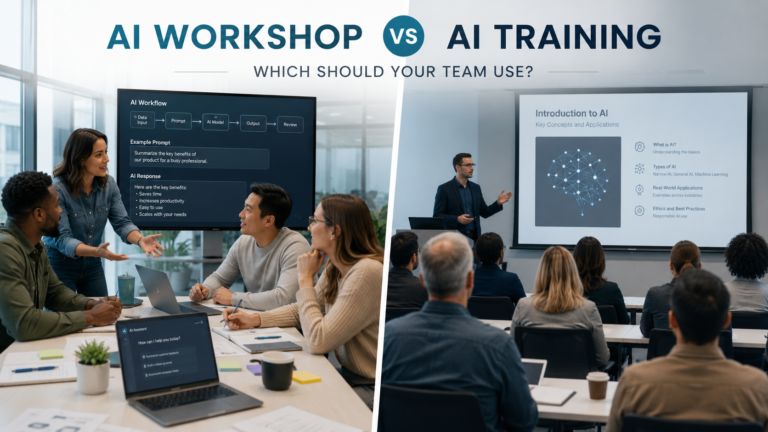
An AI workshop is a structured, hands-on learning session where you work directly with AI tools, explore how they apply to your business, and leave with a concrete plan — not just an understanding of what AI is. The key word is hands-on.
Research from ICIC, which surveyed more than 3,700 small business owners on AI adoption, found something important: most owners rely on digital resources — podcasts, webinars, online courses — to learn about AI. But those formats often lack the hands-on exposure needed to build real confidence. In-person and interactive learning, while less commonly used, is especially effective in helping entrepreneurs overcome hesitation and actually apply AI.
You don’t just know that AI can write a follow-up email. You write one, refine it, see what good looks like versus what mediocre looks like, and understand why. That kind of learning sticks.
What a workshop is not: a sales pitch for a specific AI platform, a coding class, a one-size-fits-all overview of every AI tool in existence, or a replacement for strategy. It’s an accelerator for it.
The 5 Types of AI Workshops (and Which One You Need)
Not all workshops are built the same. Knowing the difference will save you money and frustration.
| Workshop Type | Best For | Format | Duration |
|---|---|---|---|
| AI Literacy & Foundations | Teams with little AI exposure | Group / in-person or virtual | Half-day to full day |
| Executive AI Strategy | Business owners making investment decisions | Small group / facilitated | Half-day to 2 days |
| Prompt Engineering | Anyone who writes, researches, or communicates | Hands-on / individual or team | 3–4 hours |
| Workflow & Automation | Ops, admin, sales teams wanting to save time | Hands-on / team | Full day to multi-day |
| Custom / Use-Case Focused | Teams with a specific problem to solve | Tailored / facilitated | Varies |
For most small business owners, the best starting point is either an AI Literacy & Foundations workshop for the whole team, or an Executive AI Strategy session for you and any decision-makers. You don’t need to learn to build AI. You need to learn to lead with it.
What to Expect Inside a Good AI Workshop
A well-run AI workshop follows a rhythm. Here’s what that typically looks like — whether it’s half a day or a full one.
1. Orientation. Good facilitators spend the first 20–30 minutes demystifying the technology. Not a history lesson — calibration. Making sure everyone in the room has the same baseline so the rest of the session can be practical rather than definitional.
2. Your business, through an AI lens. This is where a quality workshop earns its fee. Rather than showing you generic AI demos, a skilled facilitator walks your team through mapping your own workflows — which tasks are repetitive, where the time drains are, what decisions could be better supported by data. This exercise alone is worth attending for.
3. Hands-on tool practice. You’ll actually use the tools — ChatGPT, Claude, Gemini, or whatever the workshop uses — on real tasks. Writing emails, analyzing data, summarizing documents, drafting proposals. The objective isn’t mastery in a day. It’s removing the fear and replacing it with a practical starting point.
4. Use case prioritization. By the afternoon of a good workshop, you’ll have a working list of specific AI use cases ranked by potential impact and ease of implementation. This is your roadmap.
5. Commit to a next step. The best workshops end with accountability. Every participant commits to one action in the next 48 hours — not “explore AI options,” but something specific: “I will use ChatGPT to draft our new client onboarding email by Thursday.”
“The entrepreneurs who come to this workshop are here to learn. They are engaged, curious, excited, and nervous about what this means for them. Our goal is to level the playing field for small businesses that feel like they’re getting left behind.” — Jaryn Shumaker, ICIC Lead Program Coordinator, Intuit More with AI Tour

6 Signs a Workshop Is Worth Your Time (and 4 Signs It Isn’t)
There’s no shortage of people willing to take your money for an AI training day. Here’s how to tell the difference.
Worth attending if: it’s specific to your context; the facilitator has implemented AI, not just studied it; you’ll leave with a deliverable; it addresses the why not just the how; other participants are at your level; there’s follow-up support after the day ends.
Skip it if: it leads with tools, not problems (if hour one is a product demo, you’re in a sales event); “no prior experience required” is the entire pitch; the agenda is vague; or it’s designed equally for hospitals, law firms, restaurants, and software companies — which means it’s deeply relevant to none of them.
What AI Workshops Cost — and How to Think About the Investment
| Format | Typical Cost | Notes |
|---|---|---|
| Free workshops (Google, SBA, OpenAI Academy, chambers) | $0 | Great starting point; less tailored |
| Group in-person (public) | $200–$800 / person | Mixed audiences; generic use cases |
| Private half-day session | $2,000–$8,000 | Tailored to your team; best for SMBs |
| Private full-day strategy | $5,000–$20,000 | Includes roadmapping and use case mapping |
| Hybrid program (workshop + coaching) | $800–$2,500 / person | Better retention; real-work application |
| Executive AI program | $2,500–$10,000 / person | Credential-oriented; less hands-on |
Where to Find Legitimate AI Workshops for Small Businesses
You don’t have to start with an expensive private provider. Some of the most useful AI training available right now is free or very low-cost.
Google “Make AI Work for You” — In-person workshops hosted with local chambers of commerce, online versions available. Covers AI for marketing, finance, operations, and customer support. No technical background required.
OpenAI Academy — Events, workshops, and a Small Business AI Jam program that has helped thousands of small business owners build practical AI tools. Free to participate.
SBA AI Deep Dive Workshops — A three-part in-person series covering AI basics, risk management, and automation. Free through the Small Business Administration.
SCORE and local SBDCs — Your local Small Business Development Center and SCORE chapter are increasingly offering AI literacy programming, often at no cost through federal programs.
Free workshops are excellent for getting started. But if you’re past the curiosity stage and want a real AI strategy — mapped workflows, aligned team, implementation plan — a tailored private session is worth the investment. The difference is the same as the difference between a cooking demonstration and having a chef come to your kitchen.
What to Do Before You Show Up
A workshop is only as good as what you bring to it. Showing up prepared means the time is spent on your real problems, not introductory ones.
- Write down your three biggest time drains. Tasks you or your team do most often that feel like they shouldn’t require a human. These are your best AI candidates.
- Note one decision you made last month you wish you’d had more data for. AI is excellent at synthesis and analysis — knowing your blind spots helps you target your learning.
- Create a free ChatGPT or Claude account and try one thing. Even a single interaction before the workshop means the first 30 minutes aren’t spent getting a login to work.
- Bring at least one real work document. A client email, a proposal, a process description. Workshops where you work on actual material are infinitely more useful than fictional scenarios.
- Know your team’s current AI use. Someone on your team is probably already using AI tools — knowingly or not. Find out what they’re using, what they like, and what frustrates them.
How to Apply What You Learn (Before the Energy Fades)
This is where most workshop value disappears. You have a great day, Monday hits, and three weeks later you’re back where you started. Here’s how to prevent that.
The 48-hour rule. Whatever you commit to at the end of the workshop, do it within 48 hours. If you don’t apply what you learned within two days, you’re starting from scratch. The application IS the learning.
Pick one workflow, not all of them. The most common mistake is trying to automate everything at once. Don’t. Pick the single highest-impact, most repetitive workflow and apply AI to that one thing first. Prove the value. Then expand.
Designate an internal champion. Identify one person on your team — not necessarily the most technical — who is most excited about AI. Give them explicit permission to experiment and become the in-house go-to. Peer-driven learning is faster and stickier than top-down mandates.
Build a simple prompt library. Start a shared document. Every time someone finds a prompt that gets a useful result — for a client email, a social post, a proposal — add it. This becomes a genuine team asset over time.
Schedule a 30-day review. Book a one-hour team check-in for 30 days after the workshop. Agenda: what have we tried, what’s working, what isn’t, what’s next. This turns a one-day event into an ongoing practice.
Quick Reference: AI Workshop Decision Guide
| Your Situation | Recommended First Step |
|---|---|
| Never used AI tools / complete beginner | Free Google or OpenAI workshop to build baseline |
| Used ChatGPT a few times, want structure | Public half-day workshop for practical grounding |
| Leading a team of 5–20 people | Private facilitated session tailored to your business |
| Executive needing a strategic view | Executive AI strategy workshop with roadmapping |
| Already using AI, want to go deeper | Workflow automation workshop or custom program |
| Want to build an AI-ready culture | Team-wide literacy program + internal champion model |
Frequently Asked Questions
Do I need any technical background to benefit from an AI workshop?
How is an AI workshop different from just watching YouTube tutorials?
How long does it take to see real results after an AI workshop?
What’s the difference between a public workshop and a private one?
My team is skeptical about AI. Can a workshop actually change that?
Is a one-day workshop enough, or do I need ongoing training?
Ready to Stop Learning About AI and Start Using It?
Digismart runs AI workshops specifically designed for small organizations and the leaders who run them. No jargon. No generic slide decks. We start with your workflows, your challenges, and your goals — and end with a plan your team can act on tomorrow morning.
Talk to Us About a Workshop →Details, formats, and dates: our AI workshop page · AI workshops in Miami · flat-fee pricing.